
Sergio Leone thought he was finished with Westerns. Then Paramount offered him Henry Fonda, and the result was an elegy for the whole genre, built from borrowed timber, imported dirt and music recorded before a frame was shot.
Sergio Leone’s Once Upon a Time in the West (1968) arrived as the follow-up to his Dollars trilogy and was meant to be his final word on the Western. It tells the story of a mysterious gunman, a killer for hire and the widow caught between them, all as the railroad pushes its way west. The making of it was every bit as epic, with a story shaped by two future giants of Italian cinema, a ranch built from another director’s leftovers and a score recorded before the cameras rolled. Here are 40 facts about how it all came together. For the full story, listen to our Once Upon a Time in the West episode of the All The Right Movies podcast.
1. The director had already said goodbye to the genre
After The Good, the Bad and the Ugly (1966), the final film in his Dollars trilogy, Sergio Leone believed he had said everything he wanted to say about the Old West. His heart was set on book The Hoods, a fictionalised account of Prohibition-era gangster life by the pseudonymous “Harry Grey”. Hollywood had other plans. On the back of the trilogy’s American success, the studios queuing up for Leone wanted one thing from him, and it wasn’t gangsters. The Hoods would wait until 1984, when it finally became Once Upon a Time in America.
2. Another studio arrived with the cast already chosen
United Artists, which had distributed the Dollars trilogy, was the obvious partner. Leone first floated a Western called “Remember Abilene”, about a frontier woman fighting outlaws in Kansas, with Swiss actor Ursula Andress and French star Jean-Paul Belmondo in the leads. The studio wasn’t interested without an American name. UA’s counteroffer was a Western of its own, built around Charlton Heston and Kirk Douglas. Leone wanted to pick his own actors, and turned it down.
3. Paramount promised not to read the script
The approach that worked came from Paramount, then owned by Charles Bluhdorn’s Gulf+Western conglomerate. In Leone’s telling, the head of Gulf+Western had watched one of his films in a Paris cinema and been struck less by the film than by how the audience reacted to it. Paramount wanted a Western too, but offered a $5 million budget, the right to choose the stars and creative freedom so complete that the studio wouldn’t even read the script. The real clincher was Henry Fonda, whom Paramount could deliver and whom Leone had idolised since childhood.
4. Two little girls gave the production company its name
To protect that freedom, Leone founded his own production company, Rafran Cinematografica, named after his daughters Raffaella and Francesca. It co-produced the film with Finanzia San Marco and Euro International Films, with Paramount distributing and Leone’s brother-in-law Fulvio Morsella as producer. Raffaella and Francesca also appear on screen, uncredited, among the crowd at Flagstone station when Jill first arrives in town.
5. A future Oscar winner got the job by praising horses’ backsides
Bernardo Bertolucci was 26, a published poet and the director of Before the Revolution (1964), when he caught an opening-day screening of The Good, the Bad and the Ugly in Rome. Leone was up in the projection booth, and the next day he telephoned to ask what Bertolucci had liked about it. The answer was the way he “filmed the horses’ asses”, a talent Bertolucci said only Leone and John Ford, the Hollywood master behind The Searchers (1956), possessed. Leone was delighted. “Okay,” he said, “you should write my next movie.” Two decades later, Bertolucci would win the Best Director Oscar for The Last Emperor (1987).
6. The story was built in a living room full of Westerns
In late 1966, Leone added a second young recruit, 26-year-old Dario Argento, then a critic for Italian newspaper Paese Sera and later the director of giallo horror classic Suspiria (1977). Through much of 1967, the three men met at Leone’s house in Rome to watch and pick apart High Noon (1952), The Iron Horse (1924), The Comancheros (1961) and The Searchers. Leone acted as devil’s advocate and made every final call, refusing to write anything down at first “for fear of being too satisfied with the result.” By his account, Argento was more spectator than collaborator, though “above all, good company.”
7. Putting a woman at the centre was a hard sell
No Leone film had ever been built around a female lead, and Bertolucci had to work hard to change that. By his account, Leone only came round to the lead character of Jill McBain after inventing her introduction himself: a shot from beneath the station platform, looking up her dress to reveal she wasn’t wearing underwear. The idea never made it to the shooting script. Claudia Cardinale – who played Jill – later said she was never told about it, and would probably have turned the part down if she had been.
8. The ranch’s name has two origin stories
Bertolucci always said he found the name Sweetwater on a map of the American Southwest. It also happens to appear in The Comancheros, alongside a character called McBain, and Leone biographer Christopher Frayling concludes that both explanations are true. The doomed farmer’s full name, Brett McBain, came from two American crime writers: Brett Halliday and Ed McBain, the pen name of Evan Hunter, who also wrote the screenplay for Alfred Hitchcock’s The Birds (1963).
9. The screenplay read more like a novel
To turn the treatment into something shootable, Leone brought in Sergio Donati, his long-time friend and the uncredited ghost writer on the Dollars films. Donati’s first draft ran to 436 pages, so dense with stage directions that the first spoken line didn’t arrive for around 30 of them. He also gave the film its thematic spine: the transcontinental railroad, which he called “the end of the frontier, the end of adventure.” The legless railroad baron Morton was his invention too.
Donati knew from the start the script was far too long. Leone insisted he could handle it during the shoot, until filming the massacre at Sweetwater made him realise he was heading for a five-hour film. Donati was summoned to the Spanish location to cut it down, and scenes already shot were dropped, including one in which Harmonica is beaten by the sheriff’s men. It’s the only explanation for the scar on his face.
10. The script was a mosaic of other Westerns
Frayling reckons the film quotes from as many as 30 different Westerns. The opening reverses High Noon, where men wait at a station to greet their leader rather than kill a stranger, and both films’ villains are called Frank. Leone admitted the eerie build-up to the McBain massacre, with the insects falling silent and grouse bursting from the scrub, was lifted from The Searchers. Morton’s wheelchair echoes Lionel Barrymore’s ailing patriarch in Duel in the Sun (1946), and the Sweetwater auction was designed to recall the town election in The Man Who Shot Liberty Valance (1962). Frayling calls the result “the first truly postmodernist movie,” and somehow it never once tips into parody.
11. The pitch that turned Hollywood’s good guy
The star of The Grapes of Wrath (1940) and 12 Angry Men (1957) had spent almost his entire career playing decent men, so Henry Fonda initially turned down the role of Frank. Leone flew to America to meet him, and when Fonda asked why he was wanted, the director painted a picture: “The camera shows a gunman from the waist down pulling his gun and shooting a running child. The camera pans up to the gunman’s face and… it’s Henry Fonda.” The moment proved too much for some. When the film was first shown on American television, Frank shooting the boy was cut.
12. Tuco talked him into it
Still unsure, Fonda turned to Eli Wallach, who had played the scheming Tuco in The Good, the Bad and the Ugly. Fonda later recounted the conversation on Parkinson, the BBC chat show. His concern was simple: “What does an Italian know about the American West?” Wallach’s reply was simpler still: “Go! You’ll have the time of your life!” Fonda went on to call Leone one of the greatest directors he ever worked with.
13. One final push came from the translator
Leone’s script was written in Italian, and the English version Fonda first received was stiff and literal. The rewrite fell to Mickey Knox, an American actor blacklisted during the McCarthy era who had rebuilt his career in Europe, and who had already adapted The Good, the Bad and the Ugly into English. Knox spent six weeks finding lines that kept the sense of the Italian while fitting the actors’ lip movements. It was his version that won Fonda over. In Knox’s words, “he got Henry Fonda based on my version, not the version he originally had.”
14. Frank’s villainous makeover lasted one meeting
Convinced that a villain needed a sinister look, Fonda arrived in Italy with a moustache and a pair of brown contact lenses. Leone had a close-up planned for Frank’s first appearance and wanted audiences to recognise Fonda instantly. According to Fonda’s memoir, the order was blunt: “Throw away the brown eyes. Where are the big blues? That’s what I bought.” The hat took longer. Knox remembered Fonda trying on more than 20 before he and Leone were satisfied, adding, “I didn’t think the hat was so special.”
15. A star’s refusal led to 20 years of silence
Leone’s first choice for Harmonica was Clint Eastwood, the Man with No Name from all three Dollars films. Wary of being typecast after three spaghetti Westerns in a row, Eastwood said no, and the relationship broke down. It was only repaired in 1988, when Eastwood was in Rome promoting Bird (1988), his Charlie Parker biopic, and took a call from his old director. The two had dinner. A few months later, Leone died of a heart attack.
16. Charles Bronson made the director ask four times
Leone had been chasing Bronson for years. He offered him the Man with No Name in A Fistful of Dollars (1964), but Bronson thought the script was terrible. He turned down Colonel Mortimer in For a Few Dollars More (1965) for being too similar, then had to pass on both Angel Eyes and Tuco in The Good, the Bad and the Ugly because he was already committed to The Dirty Dozen (1967). With Eastwood out and James Coburn reportedly asking too much money, Leone tried a fourth time, and Bronson finally said yes. Leone described his face as “a kind of granite block, impenetrable but scarred by life.”
17. One of Europe’s biggest stars came with money attached
Leone’s original choice for Jill was Sophia Loren, and her husband, the producer Carlo Ponti, was willing to put serious money into the film if she starred. Leone backed away, reportedly fearing that the famously headstrong Loren would try to take too much control. He turned instead to his friend Claudia Cardinale, already an international name from The Leopard (1963) and 8½ (1963). There was a practical upside too: as an Italian national, she helped secure a tax break for the co-production.
18. Cardinale got a one-man performance of the entire film
Rather than hand over the script, Leone acted out the whole story for Cardinale in person, playing the themes composer Ennio Morricone had already written as he went. “While I listened, I understood every moment of the film shot by shot,” she recalled. Leone later made her importance plain: “The whole film moves around her. If you take her out, there’s no more film.”
19. Cheyenne was written for another actor entirely
The charming bandit wasn’t in Bertolucci and Argento’s original treatment. Donati added him as a Mexican outlaw called Manuel Gutierrez, written with Eli Wallach in mind, but Leone felt audiences would only see Tuco. Kirk Douglas lobbied for the part, but it went to Jason Robards, and since nobody thought Robards made a convincing Mexican, the name became Cheyenne. Donati also handed him his fate, recycling an idea from an unproduced Western of his own about a bandit dying slowly from a gut wound.
20. Jason Robards got one warning
Robards was best known as one of America’s finest stage actors, and he was also battling alcoholism. He turned up to his first day of filming drunk, and Leone told him he’d be fired if it ever happened again. It didn’t. The one day Robards couldn’t work came in June 1968, when news broke of Robert F. Kennedy’s assassination. He broke down and refused to perform, and Leone called off filming for the rest of the day.
21. A bag of American soil travelled to Rome
The Dollars films were shot entirely in Europe, but Leone took this one to Monument Valley, John Ford’s favourite location, making it the first spaghetti Western filmed in America. That created a headache for cinematographer Tonino Delli Colli, who had to make Spain, Italy and Arizona look like one place. The red earth of the European locations photographed darker than Monument Valley’s, so the crew brought in bags of dust and used fans to blow it across the actors at eye level. For one interior shot at Cinecittà Studios in Rome, Leone had a sample of real Monument Valley earth brought back so that production designer Carlo Simi could match the colour exactly.
22. The dusters had already been in a John Ford film
Simi, a qualified architect who designed both the sets and the costumes, built the film’s look from books of period photographs, mocking the “dry-cleaned” cowboys of classic Hollywood. The gang’s famous dusters were real period riding coats, found at Western Costume Company in California, where they’d last been worn in The Man Who Shot Liberty Valance. Back then they were white. Simi had them dyed chocolate brown, explaining that in white “they looked like they were worn by ice-cream vendors.”
23. An entire town was built for a single film
Rather than reuse an existing Western set, Leone had Simi build Flagstone from scratch near La Calahorra in Granada, on land rented from a local family for ten years. Around 30 buildings went up along the main street, including the station, a hotel-saloon, a bank, a half-built theatre, a Chinese laundry, a blacksmith, a barber’s and a sawmill, some of them fully usable for interiors. The set was reused for My Name Is Nobody (1973), and the brick ruins still stand on what is now a livestock farm. It reportedly cost more than the entire budget of A Fistful of Dollars.
24. The McBain ranch had a famous previous life
Sweetwater was built by Simi in the Tabernas Desert near Almería, and the timber came with a pedigree. The logs were bought from the production of Orson Welles’s Chimes at Midnight (1965), his Shakespearean Falstaff film shot in Spain a few years earlier. Leone began shooting there on 14 May 1968, and the ranch house still stands today as a tourist attraction called Western Leone.
25. The production laid its own railway
Sweetwater wasn’t on a rail line, and Leone refused to fake the train for the finale. So the crew bulldozed a cut through the terrain and laid around two kilometres of track to the set. The engine was a retired Spanish State Railways locomotive, withdrawn in 1967, dressed with an American-style smokestack and cowcatcher and hauled across country on a low-loader. As Delli Colli put it, “Sergio even had two kilometres of railway built and arranged for the locomotive and wagons to be transported to the canyon.”
26. The opening station was designed to look like something else
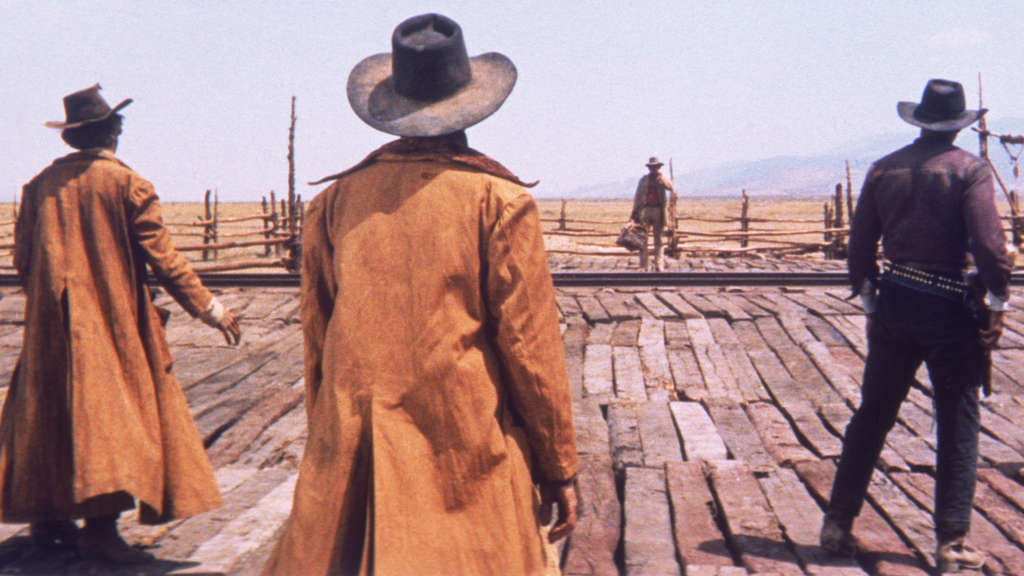
Cattle Corner, where three gunmen wait for a train in the film’s near-wordless ten-minute opening, was built around a disused railway station at La Calahorra. Simi’s suggestion was that instead of “a station that looks like a station,” they should build one that looked like an old abandoned wagon, dusty and half-sunk into the landscape. Holes were cut in the wooden platform so the camera could sit low and look up at the gunmen. Leone called the finished sequence “the summa” of his career.
27. The opening was meant to kill off the Dollars trilogy
Leone originally wanted the three gunmen played by Clint Eastwood, Lee Van Cleef and Eli Wallach, the Good, the Bad and the Ugly themselves. Gunning them down in the first scene would have been a symbolic farewell to the trilogy he wanted to put behind him. Wallach was reportedly willing, but Eastwood said no, and the idea was dropped. Instead, the roles went to three veterans of Hollywood Westerns: Woody Strode, Jack Elam and Al Mulock.
28. Jack Elam’s fly was lured with jam
Elam, a wall-eyed character actor who had appeared in High Noon, spends much of the opening tormented by a fly, which he eventually traps in the barrel of his gun. Getting a fly to cooperate took some ingenuity. The crew smeared his face with jam, started rolling on close-ups and released flies from a jar until one landed on his cheek. Donati later insisted the fly at the station was his idea.
29. Woody Strode turned a problem into a moment
Strode’s gunman spends the opening standing beneath a leaking water tower, and the drips landing on his hat kept making him flinch. Leone stopped filming and was ready to move him, but Strode suggested staying put, wanting his character to look too cool to care. On the spur of the moment, Leone had him take off the hat and drink the water collected in the brim. The Native American woman who flees the station at the start of the scene was played by Strode’s wife, Luana.
30. Tragedy struck one of the three gunmen
Al Mulock, who had played the one-armed bounty hunter Tuco shoots in the bath in The Good, the Bad and the Ugly, was cast as Knuckles. After a day’s filming, still in costume, he took his own life by jumping from his hotel window. Production manager Claudio Mancini and Mickey Knox saw him fall past their window. As Mancini put Mulock in his car to rush him to hospital, Knox recalled Leone calling after him: “Get the costume! We need the costume!” A double was used to complete the scene.
31. An avant-garde concert replaced the opening music
Morricone had written a cue for the Cattle Corner sequence, but it didn’t fit. Then he told Leone about a performance he’d seen in Florence, in which a man stood in silence making a stepladder creak into a microphone. The point, as Morricone put it, was that an everyday sound isolated by silence “becomes something different.” Leone took the idea and built the opening from amplified natural noise instead: the squeaking windmill, the telegraph, footsteps, the buzzing fly. Morricone called it “one of the best things Sergio did in this film.”
32. Close-ups were saved for the end of the day
Shot in Techniscope, a cheap widescreen process that used half the film stock of standard 35mm, the film is famous for jumping from vast landscapes to faces that fill the screen. Delli Colli explained the routine: wide shots first thing while the light was good, extreme close-ups in the evening, when nothing else needed to be in frame. Days ran 14 to 15 hours, and 30 takes was normal. Any objections got short shrift, with Leone telling the crew, “Bugger off, we’ll continue till I am ready.”
33. Claudia Cardinale’s first scene had an audience
Her very first day on set was the love scene between Jill and Frank, and it was also the first love scene of Henry Fonda’s long career. Fonda’s wife, Shirlee, insisted on being there. Cardinale remembered being nervous, Fonda being tense, and Shirlee watching from behind the camera “like a vulture, which completely paralyzed me.” By her account, it took two days to complete the scene.
34. The music arrived before the cameras did
Film scores are usually written to a finished cut, but Morricone composed his main themes from the script and recorded them before shooting began. Leone played them on set so the cast could perform to the music, and when the script changed during production, he directed the new scenes to fit the score. The effect on set could be overwhelming. Donati remembered filming Jill’s arrival at Sweetwater, where the murdered McBains lie laid out on tables, at sunset in Almería: “Everybody on the set was crying. Even the grips, the tough guys were crying.”
35. A crane shot was timed to a crescendo
Jill’s arrival at Flagstone is one of the film’s most celebrated shots, around 85 seconds unbroken. The camera follows her along the platform, watches through the window as she waits in the station office, then rises over the roof to reveal the whole half-built town and the desert beyond. Because “Jill’s Theme”, with Edda Dell’Orso’s soaring wordless vocal, was already recorded and playing on set, Leone controlled the speed of the crane so it peaked with the music.
36. Cheyenne’s theme was unlocked by a Disney dog
Every lead has their own musical theme, but the bandit’s gave Morricone trouble. The breakthrough came when Leone told him to think of Cheyenne as the Tramp from Disney’s Lady and the Tramp (1955), a character with “intelligence and instinct… a great tenderness.” The result is a loose, clip-clopping tune on piano and banjo, with whistling from Alessandro Alessandroni, who was asked for something “soft and tired, with no vibration.”
37. Bronson never played a note
The wailing harmonica that follows Harmonica everywhere was played by Franco De Gemini, Morricone’s go-to session player, who had also worked on A Fistful of Dollars. He went on set to coach Bronson on handling the instrument, and Leone was so pleased he promised him a gold harmonica. It never arrived. De Gemini liked to say he was the only musician famous for three notes.
38. American audiences saw a very different film
Leone’s cut ran around 165 minutes and played across continental Europe at that length. In the US, Daily Variety called it “heavy going”, and while accounts of what happened next vary, trade evidence gathered by the American Film Institute suggests it opened in New York at full length on 28 May 1969 and had been trimmed to around 135 minutes by the time it reached Los Angeles that July. The trading post scene that introduces Cheyenne vanished, leaving veteran character actor Lionel Stander credited as its barman but nowhere to be seen. Cheyenne’s death went too. Critic Dave Kehr said the American version “no longer made even rudimentary narrative sense.”
The Academy wasn’t paying attention either. The film didn’t receive a single Oscar nomination, not for Fonda, not for the cinematography and not even for Morricone’s score.
39. Paris department stores had to issue a safety warning
France, however, embraced the film like nowhere else, and the gang’s long dusters became the must-have coat of the moment. The craze for these “maxi” coats grew so intense that the Paris department store Au Printemps had to put up signs on its escalators, warning customers to keep their hems clear of the machinery.
40. One Paris projectionist had seen quite enough
Leone was proud that one Paris cinema had played his film uninterrupted for two years, and when he visited, he was mobbed by fans wanting his autograph. One man was less pleased to see him. According to Leone’s own oft-told story, the cinema’s projectionist confronted him with a complaint: “I kill you! The same movie over and over again for two years! And it’s so SLOW!”
Ignored by the Oscars and cut to pieces in America, Once Upon a Time in the West has since become one of the most admired Westerns ever made, and its fingerprints are everywhere. Robert Zemeckis nods to the Flagstone crane shot in Back to the Future Part III (1990), John Carpenter had “Jill’s Theme” played as he walked down the aisle to marry Adrienne Barbeau, and Quentin Tarantino borrowed the title for Once Upon a Time in Hollywood (2019). For the full story behind Leone’s farewell to the West, listen to our ATRM Classic episode on the All The Right Movies podcast.
The H1 uses title option 1. If you go with another option, swap the H1 to match.
Latest Podcast Episodes
Latest Features
The beginning of a beautiful friendship
Stay up-to-date with all things All The Right Movies by signing up for our e-newsletter.